
Say “types of buses” and most people picture a yellow school bus. Or a city bus stuck in traffic. That’s just a small part of the picture. Buses handle daily commutes. They also cover long trips, group tours, and specialized needs. No two types work the same way.
Picking the right one isn’t guesswork. A family plans trips with more confidence. A business moves teams without last-minute scrambling. A school gets large groups where they need to go, on time. It comes down to distance, group size, and comfort.
Buses remain the smartest choice for group travel. One bus carries dozens of people, meaning fewer cars on the road. They’re easier on the budget too. A city bus and a luxury coach look different, but both move people. At Party Bus Rentals DC we help you find the right fit.
Your Guide to the Different Types of Commercial Buses
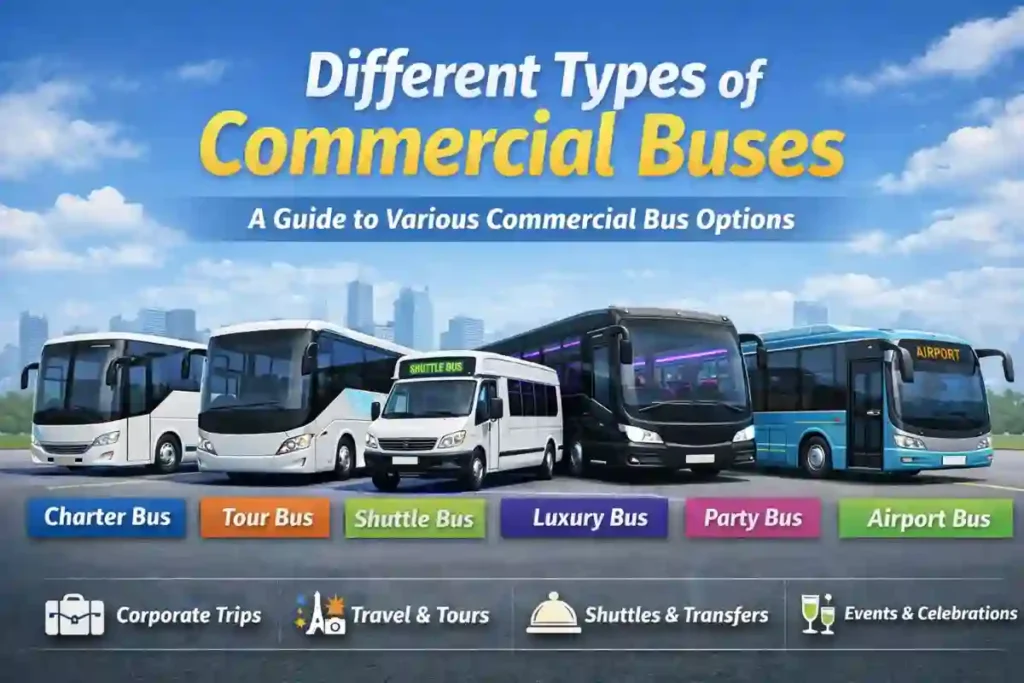
Different~Types~of~Commercial~Buses
Commercial buses move large groups on a professional scale. Businesses rely on them for school routes, corporate transport, and private charters. These vehicles are built stronger than regular cars. They run longer hours. They cover more miles.
Fuel efficiency matters more than ever. Diesel buses remain the most common choice on the road. But electric, hybrid, and CNG buses are gaining ground fast. Each option cuts emissions. Each one lowers long term operating costs. This shift is pushing fleets toward greener, smarter transportation.
Transit types of Buses and City Transportation
Transit buses, or city buses, keep people moving across cities. They run on fixed routes with regular schedules. They handle heavy foot traffic and make frequent stops throughout the day.
Transit buses offer both seating and standing space. This design fits more passengers during rush hour. Many modern models feature low floors, wide doors, and wheelchair access.
As cities grow, electric city buses are replacing older diesel models. They run cleaner and quieter, improving the urban environment.
Best for:
- Daily city commuters and public transportation systems
- High traffic urban routes with frequent stops
Coach Buses for Long-Distance Travel
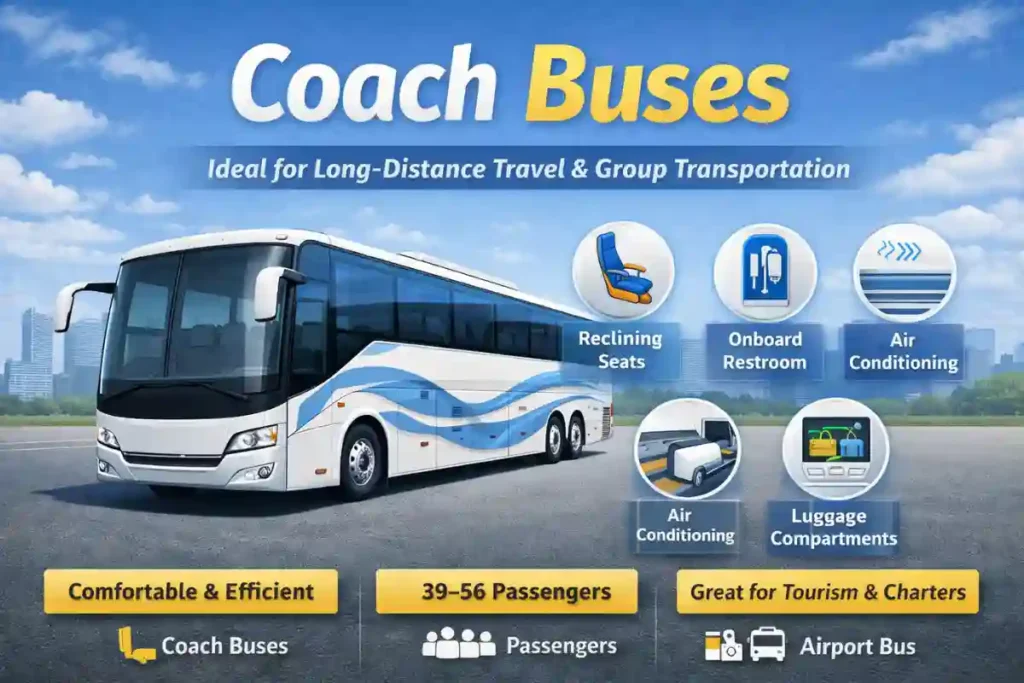
Coach buses are built for comfort on long trips. They serve intercity routes, tourism, charters, and corporate travel. Unlike transit buses, they focus heavily on passenger comfort and onboard amenities.
A standard coach bus seats 39 to 56 passengers, depending on layout. Common features include reclining seats, air conditioning, onboard restrooms, and luggage storage. These features make coach buses the top choice for long distance travel.
Best for:
- Intercity travel and long distance tours
- Corporate events, school trips, and large group charters
School Buses and Student Safety
School buses are one of the most familiar forms of transportation. They carry students safely and efficiently. Their bright yellow color and reinforced structure make them easy to spot. A typical school bus holds 48 to 72 students, depending on size and seat layout. Most buses have 12 to 15 rows of bench seating. Standard models run on six wheels, while larger versions use eight.
Best for:
- Daily home to school student transportation
- School districts needing safe, high capacity group travel
Understanding Different Types of School Buses
School buses come in four main types: A, B, C, and D. Each type fits a different route and capacity need.
- Type A: Built on a van chassis. Smaller in size. Best for rural routes and short trips.
- Type B: Slightly larger than Type A. Less common on the road today.
- Type C: The classic yellow school bus. Most widely used across school districts.
- Type D: Flat front design with the largest seating capacity. Built for large school districts with high student numbers.
Schools choose the right type based on student count, route length, distance, and budget.
Shuttle Buses for Short Distance Routes
Shuttle buses are meant to make short and frequent journeys. They are typically deployed at airports business parks, hospitals and large scale events. Airport shuttle Types of Buses, such as those in use at airports, move people in and out of the terminals, car parks and surrounding hotels. Shuttle buses are commonly used when the bus has fewer customers as compared to full size buses, and they are therefore effective in making frequent trips. They are small in size, fit into small areas with ease, and offer comfortable seating.
Best for:
- Airport, hotel, and hospital transfers
- Short, frequent trips for smaller groups
Mini Buses for Small Groups
Mini buses are an excellent solution for small group transportation. These buses typically seat between 15 and 22 passengers. They are often used for tours, private events, schools, and corporate travel.
Because of their size, mini buses are easier to operate in urban environments and require less fuel than larger buses.
Best for:
- Small group tours and school outings
- Corporate travel needing an easy to maneuver vehicle
Luxury and Executive Buses
Premium group transportation is done using luxury and executive buses. These buses are comfortable, stylish and modernized. They are usually used in corporate executives, VIP guests and high end events. Interior options might be leather seats, Wi Fi, power outlets, air conditioning, and entertainment. Types of Buses Luxury coach buses are a combination of the standard bus size and the first class traveling coach.
Best for:
- VIP guests and corporate executive travel
- High end events needing a premium, comfortable ride
Party Buses for Every Celebration
Party buses turn travel time into part of the celebration. They come with a mini bar, a sound system, and open space to move around. Groups use them for birthdays, bachelor and bachelorette parties, proms, and nights out on the town.
Party bus size depends on group size. Smaller buses suit tight friend groups. Larger buses handle full wedding parties or big office celebrations.
- 20 Passenger Party Bus: Fits up to 20 guests. Comes with a mini bar and a dance pole. Best for small parties, birthdays, and nights out.
- 28 Passenger Party Bus: Fits up to 28 guests. Includes a mini bar and a dance pole. Best for larger celebrations, bachelor/bachelorette parties, and group nights out.
- 40 Passenger Party Bus: Fits up to 40 guests. Built with a mini bar and a dance pole for maximum energy. Best for weddings, large corporate parties, and big group events.
Limousine Buses for Small Groups
Limo buses blend the comfort of a limousine with the space of a bus. They’re a strong pick for smaller groups who still want a mini bar, music, and a private ride.
- MKT Limo: Seats 8 to 10 passengers. Comes with a mini bar and a sound system. Best for small groups, date nights, and intimate celebrations.
- Sprinter Limo: Seats 10 to 13 passengers. Includes a mini bar and music setup. Best for airport runs, small parties, and corporate outings.
- Hummer Limo: Seats 11 to 20 passengers. Features a mini bar and a full sound system. Best for bold entrances, bachelor parties, and milestone celebrations.
Other Specialized Bus Types
Beyond the common types, a few specialized buses serve specific travel needs.
1. Double Decker Buses
These buses have two levels of seating, offering extra capacity and a great view.
- Best for: City sightseeing tours, hop on hop off routes, and scenic group travel.
2. Minicoach
A mid size option between a minibus and a full coach. It offers more seats than a minibus but stays easier to maneuver than a full size coach.
- Best for: Mid size groups needing more comfort than a minibus but not a full charter bus.
Low Floor and ADA Accessible Buses
These buses feature low entry steps, wide doors, and wheelchair ramps or lifts.
- Best for: Passengers with mobility needs, senior groups, and inclusive city transit.
1. Sleeper Buses
Built with sleeping berths instead of standard seats, these buses let passengers rest during long trips.
- Best for: Overnight group travel, band tours, and long distance journeys where comfort matters most.
Fuel Types and Modern Bus Technology
Contemporary buses are of various types of fuel. Diesel buses have been researched to be dependable and strong, particularly on long distance routes. The electric buses are gaining popularity in the cities because they are non polluting and cause no noise pollution.
Hybrid buses are good in fuel consumption and environmental impact, whereas CNG buses are another alternative that is more sustainable in the environment than traditional fuel. The bus fleet management systems enable operators to enhance performance, enhance safety and reduce the cost of maintenance with the advancement in technology.
Key Factors to Consider When Choosing a Bus
Choosing the right bus comes down to a few key factors. Start with seating capacity and travel distance. Fuel type and passenger comfort matter too. Safety features, accessibility, and operating costs all play a role. Schools and transit systems must also follow strict safety guidelines.
For events and group outings, group size and occasion type guide the decision. A small friend group may need a limo bus, while a large celebration calls for a full size party bus.
Weighing these factors helps you pick a bus that fits your group’s needs and keeps operations efficient.
Party Bus and Limo Pricing
| Vehicle | Passenger Capacity | Starting Price |
| MKT Limo | 8 to 10 | $135/hr |
| Sprinter Limo | 10 to 13 | $175/hr |
| Hummer Limo | 11 to 20 | $175/hr |
| Party Bus | 18 to 30 | $185/hr |
| Party Bus | 30 to 40 | $220/hr |
Party Bus and Limo Service in the Washington DC Area
We provide party bus and limo rentals across the greater Washington DC region. Whether your event is downtown or in a nearby suburb, our fleet reaches you.
1. Washington DC
From Georgetown to Capitol Hill, we cover the city for weddings, tours, nightlife, and corporate events. Traffic and parking are no issue with a private ride.
2. Northern Virginia
We serve Arlington, Alexandria, and Fairfax for airport transfers, weddings, and group nights out. Our buses make it easy to move across the DMV without multiple cars.
3. Maryland Suburbs
Groups in Bethesda, Silver Spring, and Rockville rely on us for proms party bus birthdays, and corporate travel. We handle pickups and drop-offs across the region with ease.
Frequently Asked Questions
1. How many humans can a college bus accommodate?
A popular school bus can maintain between forty eight and seventy two students, relying on size and seating association.
2. How many seats are there on a college bus?
Most college buses have between 24 and 36 bench seats.
3. What are the principal varieties of buses?
The important kinds include faculty buses, town buses, coach buses, shuttle buses, and minibuses.
4. What's the difference between a party bus and a limo bus?
A party bus offers open floor space, a dance pole, and room to stand and move. A limo bus keeps traditional limousine seating with a more intimate, seated layout for smaller groups.
5. How many people fit on a party bus?
Party bus capacity ranges from 18 to 40 passengers, depending on the model. Smaller buses suit tight friend groups, while larger buses handle full wedding parties or big celebrations comfortably.
Final Thoughts
Buses today serve far more than daily commutes. From school buses and coaches to shuttle buses and specialized vehicles, each type is built for a specific purpose. Passenger capacity, comfort features, and route needs all shape the right choice.
Party buses and limos add another layer of options for group celebrations. Whether it’s a birthday, wedding, bachelor party, or night out, the right vehicle turns transportation into part of the experience.
Understanding these bus types helps you make an informed choice, whether you’re planning daily transit, a long tour, or a night to remember.
Ready to book your ride Explore our fleet of party buses and limos at Party Bus Rentals and get a custom quote today.